
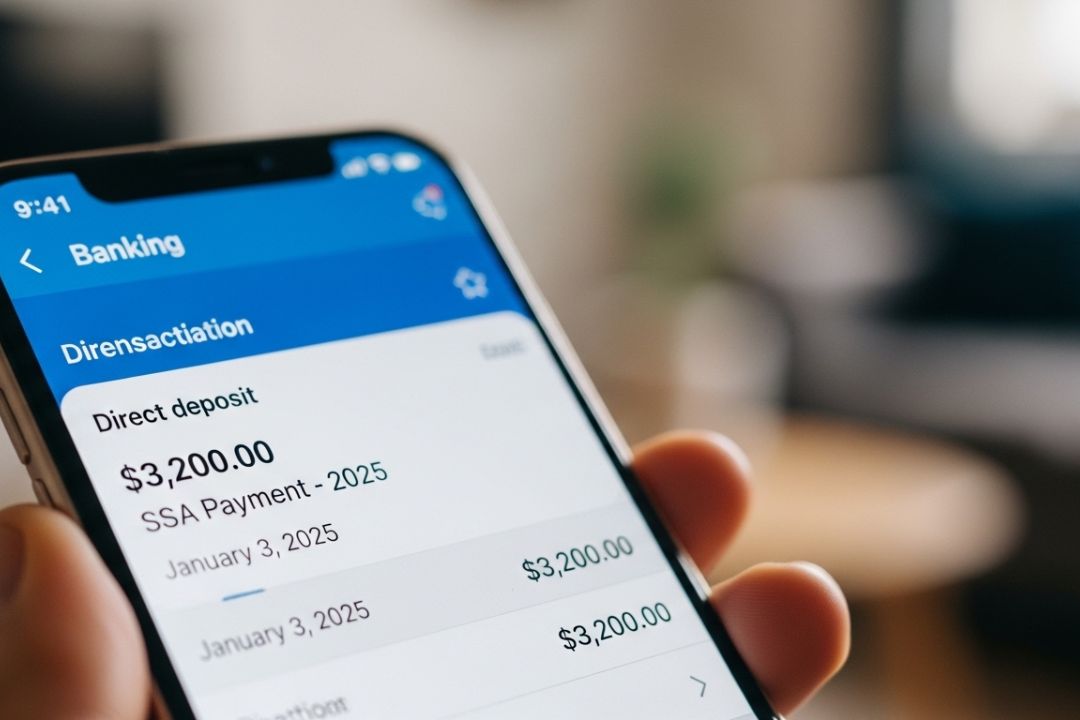
Every year, millions of Americans who depend on Social Security wake up wondering — is there a raise coming? Will my check be bigger this year? In 2025, that conversation has gotten louder than ever. You may have already seen headlines or social media posts talking about a SSA $3200 Direct Deposit Payment 2025. If you are one of the many people trying to figure out whether this is real, who qualifies, and how to make sure you receive it — you are in exactly the right place.
This guide breaks everything down in plain language. We will cover what the SSA $3200 direct deposit payment actually is, the role of the Cost-of-Living Adjustment (COLA), who is eligible, when payments go out, and what steps you can take to maximize your monthly benefits. Whether you are a retiree, a disability recipient, or a family member helping a loved one navigate the system, this article has everything you need to know.
What Is the SSA $3200 Direct Deposit Payment 2025?
Let us start with the basics. The Social Security Administration (SSA) is a federal agency that manages retirement, disability, and survivor benefits for tens of millions of Americans. Each year, the SSA adjusts benefit amounts to account for inflation. This adjustment is called the Cost-of-Living Adjustment, or COLA.
The SSA $3200 Direct Deposit Payment 2025 refers to the maximum monthly benefit amount that certain Social Security recipients — particularly those who retired at the optimal age and contributed at the maximum level for decades — can receive in 2025. This figure is not a one-time stimulus check or a special government bonus. It is the top-tier monthly payment available under the Social Security retirement program.
For 2025, the COLA increase was set at 2.5%, which was applied to all Social Security benefit amounts starting in January 2025. For high earners who delayed retirement and maximized their contributions, this brings their monthly benefit close to or at the $3,200 level, depending on individual work history and the age at which they claimed benefits.
Understanding the 2025 COLA Increase
The Cost-of-Living Adjustment is calculated each year using data from the Consumer Price Index for Urban Wage Earners and Clerical Workers (CPI-W). The Social Security Administration compares average CPI-W figures from the third quarter of the current year against the same period from the previous year. If prices have gone up, benefits go up by the same percentage.
For 2025, that percentage was 2.5%. This means that if you were receiving $2,000 per month in 2024, your new monthly payment in 2025 is approximately $2,050. For those already at the higher end of the benefit scale, this 2.5% bump can push their total monthly payment right into the $3,100 to $3,200 range.
Here is a quick look at recent COLA history to put 2025 in perspective:
- 2022 COLA: 5.9% — the largest increase in nearly 40 years
- 2023 COLA: 8.7% — the highest in over four decades due to peak inflation
- 2024 COLA: 3.2% — a modest pullback as inflation cooled
- 2025 COLA: 2.5% — a further normalization as economic conditions stabilized
While 2.5% may seem small compared to 2023, it still represents real money in people’s pockets. For someone receiving $3,100, a 2.5% increase means an extra $77.50 per month, or roughly $930 extra over the full year.
Who Qualifies for the $3200 Direct Deposit Payment?
Not everyone who receives Social Security will get $3,200 per month. This is the maximum benefit, and it is only available to people who meet all of the following criteria:
1. Worked for at Least 35 Years
Social Security benefits are calculated based on your 35 highest-earning years. If you have fewer than 35 years of work history, the SSA fills in the missing years with zeros, which lowers your average and reduces your benefit. To receive maximum benefits, you need a full 35-year work record.
2. Earned at or Near the Maximum Taxable Wage
Each year, the SSA sets a maximum taxable earnings limit — the amount of income subject to Social Security payroll taxes. In 2025, that cap is $176,100. To qualify for maximum benefits, you need to have earned at or near this cap for most of your working years. Most workers never reach this level, which is why the average Social Security benefit is much lower than $3,200.
3. Delayed Retirement Until Age 70
This is perhaps the most important factor. You can claim Social Security as early as age 62, but doing so permanently reduces your benefit. Your full retirement age (FRA) depends on your birth year — for most people born after 1960, it is 67. If you wait until age 70, you earn delayed retirement credits worth 8% per year beyond FRA. That means someone who waits until 70 instead of claiming at 67 gets a 24% larger monthly check for the rest of their life.
The combination of maximum earnings, 35+ years of work, and delaying to age 70 is what puts someone in the $3,200 bracket for the SSA $3200 Direct Deposit Payment 2025.
2025 SSA Maximum Benefit Amounts by Age
Here is a breakdown of the maximum monthly Social Security retirement benefit amounts for 2025, depending on the age at which you claim:
| Retirement Age | Max Monthly Benefit (2025) | Notes |
| Age 62 (Early) | $2,831 | Permanently reduced benefit |
| Age 67 (Full Retirement Age) | $4,018 | Full benefit — no reduction or bonus |
| Age 70 (Maximum Delay) | $5,108 | Highest possible; 24% bonus over FRA |
| Average recipient (all ages) | ~$1,907 | Most common monthly payment |
Note: The $3,200 figure frequently referenced in headlines reflects a common benchmark for high-earning beneficiaries, particularly those who retired in prior years and are now receiving their 2025 adjusted benefit including COLA. The exact maximum amounts shown above are the official 2025 SSA figures.
SSA $3200 Direct Deposit Payment 2025: Payment Schedule
One of the most common questions people ask is: when will the money arrive? The SSA runs a structured payment schedule each month based on beneficiaries’ birth dates. Here is how it works:
For Retirement, Disability (SSDI), and Survivor Benefits
- Born on the 1st through 10th of any month: Payment arrives on the second Wednesday
- Born on the 11th through 20th: Payment arrives on the third Wednesday
- Born on the 21st through 31st: Payment arrives on the fourth Wednesday
There is one exception: if you started receiving Social Security benefits before May 1997, your payment always comes on the 3rd of the month, regardless of your birth date.
For SSI (Supplemental Security Income) Recipients
SSI payments follow a different schedule. They are paid on the 1st of each month. If the 1st falls on a weekend or federal holiday, the payment is issued on the preceding business day.
All payments for the SSA $3200 Direct Deposit Payment 2025 follow this same calendar. If you have direct deposit set up, the funds will typically appear in your bank account by 9 a.m. on your scheduled payment day. If you receive paper checks, allow a few extra days for delivery.
How Direct Deposit Works for SSA Payments
The SSA strongly encourages all beneficiaries to receive their payments via direct deposit. In fact, for anyone who applied for benefits after May 2011, direct deposit is required unless there is a valid exception (such as no bank account).
Benefits of Direct Deposit
- Faster access — funds arrive on the scheduled day, not days later via mail
- Safer — no risk of a check being lost, stolen, or damaged
- More convenient — no trip to the bank required
- Works even if you move — as long as your bank account stays the same
How to Set Up or Change Direct Deposit
Setting up direct deposit for your Social Security benefits is straightforward. You have three options:
- Online: Log in to your My Social Security account at ssa.gov and update your payment information directly.
- By phone: Call the SSA at 1-800-772-1213. TTY users can call 1-800-325-0778. Representatives are available Monday through Friday, 8 a.m. to 7 p.m. local time.
- In person: Visit your nearest Social Security office. You can find locations at ssa.gov/locator.
You will need your bank’s routing number and your account number. The SSA can send payments to checking accounts, savings accounts, or prepaid debit cards that have been set up for direct deposit.
Average vs. Maximum: What Most People Actually Receive
It is important to be clear-eyed about expectations. While the SSA $3200 Direct Deposit Payment 2025 represents what is possible at the top of the benefit scale, the reality for most Social Security recipients looks quite different.
As of early 2025, the average monthly Social Security retirement benefit is approximately $1,907. The average for disabled workers receiving SSDI is roughly $1,580, and the average for SSI recipients is around $943 per month.
These averages tell a story about who most Social Security recipients are. The majority are moderate-income workers who did not earn near the taxable maximum, may have had gaps in their work history, or claimed benefits before reaching age 70.
Real-Life Example: How Benefit Amounts Are Determined
Consider two workers, both retiring in 2025 at age 67:
- Worker A earned an average of $60,000 per year for 35 years and claimed at their full retirement age of 67. Their monthly benefit is approximately $2,200.
- Worker B earned at or above the taxable maximum every year for 35 years and also claimed at 67. Their benefit is approximately $4,018 per month — the 2025 maximum at FRA.
- Worker C, similar to Worker B, but delayed claiming until age 70. Their monthly benefit jumps to approximately $5,108 — the 2025 maximum at age 70.
The $3,200 range tends to represent those high earners who either claimed slightly before 70 or who retired in prior years and have been receiving COLA adjustments over time. It is a very real number for a specific slice of the beneficiary population.
Can You Increase Your Social Security Benefits?
If you are not yet at the maximum benefit level, there are several strategies worth knowing about. While not everyone can reach the $3,200 mark, these approaches can meaningfully increase what you receive.
Strategy 1: Delay Claiming Benefits
Every year you wait past your full retirement age adds 8% to your benefit, up to age 70. If your FRA is 67 and you wait until 70, you earn a permanent 24% bonus. Over a 20-year retirement, that can add up to tens of thousands of dollars in additional income.
Strategy 2: Work Longer to Boost Your Earnings Record
If you have some low-earning or zero-earning years in your 35-year calculation, replacing them with higher-earning years by working a few more years can increase your benefit. Even one or two extra working years at a good salary can make a noticeable difference.
Strategy 3: Coordinate Spousal Benefits
Married couples have options for coordinating their benefits to maximize household income. For instance, a lower-earning spouse might claim early while a higher-earning spouse delays to age 70. This strategy allows the household to receive some income now while still building toward the maximum delayed benefit.
Strategy 4: Check for Survivor Benefits
If you are a widow or widower, you may be eligible for survivor benefits based on your deceased spouse’s work record. In some cases, these benefits are higher than your own, and it is worth comparing the two. You can switch to the higher benefit at the appropriate time.
Strategy 5: Verify Your Earnings Record
Errors in your Social Security earnings record can reduce your benefits. Log in to My Social Security at ssa.gov and review your earnings history. If you find any mistakes — missing years of employment, incorrect wages listed — report them to the SSA and provide documentation. Correcting even one year of missing earnings can increase your monthly benefit.
Taxes on Social Security Benefits in 2025
Many people are surprised to learn that Social Security benefits can be subject to federal income tax. Whether your benefits are taxed depends on your combined income, which the IRS defines as your adjusted gross income plus non-taxable interest plus half of your Social Security benefits.
Here is how the tax thresholds work for 2025:
- If your combined income is below $25,000 (individual) or $32,000 (married filing jointly), your benefits are not taxed.
- If your combined income is between $25,000 and $34,000 (individual) or $32,000 and $44,000 (joint), up to 50% of your benefits may be taxable.
- If your combined income is above $34,000 (individual) or $44,000 (joint), up to 85% of your benefits may be taxable.
For recipients of the SSA $3200 Direct Deposit Payment 2025, especially those who also have retirement accounts, pensions, or investment income, it is very common for benefits to be at least partially taxable. Consulting with a tax professional or financial advisor can help you plan accordingly and potentially reduce your tax burden through strategic withdrawal timing or other methods.
SSA $3200 Direct Deposit Payment 2025 and SSDI Recipients
The Social Security Disability Insurance (SSDI) program is separate from retirement benefits, but it also received the 2025 COLA increase of 2.5%. SSDI benefits are based on your work history and earnings record — the same formula used for retirement benefits.
The maximum SSDI benefit in 2025 is the same as the maximum retirement benefit for someone at their full retirement age, which is $4,018. However, the average SSDI payment is much lower, at around $1,580 per month, because most disability recipients had not reached their peak earning years before becoming disabled.
When an SSDI recipient reaches their full retirement age, their benefits automatically convert to Social Security retirement benefits at the same amount. This transition happens automatically — no application is required.
What About SSI — Is It Different from SSDI?
Yes, SSI (Supplemental Security Income) and SSDI are two completely different programs, and it is worth understanding the distinction, especially when discussing the SSA $3200 Direct Deposit Payment 2025.
- SSDI is based on your work and earnings history. You must have paid Social Security taxes to qualify.
- SSI is needs-based. It is available to low-income individuals who are 65 or older, blind, or disabled — regardless of work history.
For 2025, the maximum federal SSI payment is $967 per month for an individual and $1,450 per month for a couple. Some states add a supplemental payment on top of this.
SSI recipients will not receive the $3,200 figure discussed in this guide — that is specific to Social Security retirement and SSDI programs. However, SSI payments also received the 2.5% COLA increase for 2025, which is meaningful for recipients who rely on every dollar.
How to Check Your Payment Status
Whether you are already receiving Social Security benefits or are planning to apply, there are easy ways to stay on top of your payment information:
My Social Security Online Account
The best tool available is the My Social Security portal at ssa.gov/myaccount. Once you create a free account, you can:
- View your payment history
- See your benefit amount and upcoming payment dates
- Update your direct deposit information
- Request a replacement Social Security card
- Get a benefit verification letter
- Review your complete earnings record
The SSA Mobile App
The SSA does not currently have its own standalone app, but My Social Security is mobile-friendly and works on any smartphone browser. Third-party apps exist, but always verify they are official government sources before entering personal information.
Call the SSA
You can reach the SSA at 1-800-772-1213 (TTY: 1-800-325-0778) Monday through Friday, 8 a.m. to 7 p.m. Wait times can be long, especially at the start of each month, so calling mid-morning on a Tuesday or Wednesday tends to be faster.
Beware of Social Security Scams in 2025
Whenever large dollar figures are associated with government payments, scammers take notice. The SSA $3200 Direct Deposit Payment 2025 has become a topic that fraudsters are exploiting to trick people into giving up personal information or money.
Here are the most common Social Security scams you should watch out for:
- Phone calls claiming your Social Security number has been suspended and demanding payment to restore it — the SSA does not suspend Social Security numbers.
- Emails or texts saying you qualify for a special $3,200 payment if you click a link and provide your banking details — the SSA will never contact you this way.
- Fake government websites that look like ssa.gov but have slightly different URLs.
- Callers demanding gift card payments or wire transfers — government agencies do not accept these.
If you receive any suspicious communication, hang up or delete it and contact the SSA directly at the official number: 1-800-772-1213. You can also report scams to the SSA Office of Inspector General at oig.ssa.gov.
Future Outlook: Social Security Beyond 2025
A common concern among Social Security recipients and future retirees is the long-term financial health of the program. The Social Security trust funds are projected to face funding challenges in the coming decades. The most recent SSA Trustees Report projected that the combined trust funds could be depleted around 2035, at which point incoming payroll tax revenue would cover only about 83% of scheduled benefits.
This does not mean Social Security will disappear. Congress has historically acted to shore up the program before reaching critical thresholds, and various policy proposals are on the table — including raising the taxable earnings cap, adjusting the retirement age, and modifying the COLA calculation formula.
For current retirees and those close to retirement age, the SSA $3200 Direct Deposit Payment 2025 and future COLA adjustments remain on solid footing. The uncertainty primarily affects younger workers who will not retire for 20 or 30 years, giving Congress ample time to find solutions.
Conclusion: What You Need to Know About the SSA $3200 Direct Deposit Payment 2025
The SSA $3200 Direct Deposit Payment 2025 is real — but it is important to understand exactly what it represents. It is not a one-time bonus or a new government program. It reflects the maximum monthly benefit available to high-earning workers who maximized their Social Security contributions, worked for at least 35 years, and strategically delayed their retirement claims.
For millions of Americans, the 2025 COLA increase of 2.5% means a slightly larger check arriving in their bank account every month. The those at the top of the benefit scale, that can mean payments close to or at the $3,200 range. For the average recipient, the increase still adds meaningful income over the course of the year.
The key takeaways from this guide are:
- The $3,200 figure represents the higher end of monthly Social Security benefits after the 2025 COLA adjustment.
- Qualifying depends on your work history, earnings level, and the age at which you claim benefits.
- Direct deposit is the fastest, safest way to receive your payments.
- Your payment date is tied to your birth date, not a universal calendar.
- There are legitimate strategies to increase your benefits, including delaying claiming and correcting your earnings record.
- Be alert to scams that use dollar figures like $3,200 to steal personal information.
If you have not already done so, create a My Social Security account at ssa.gov today. Review your earnings record, check your projected benefit, and start planning to make the most of what you have earned. Your retirement security is worth the attention.