
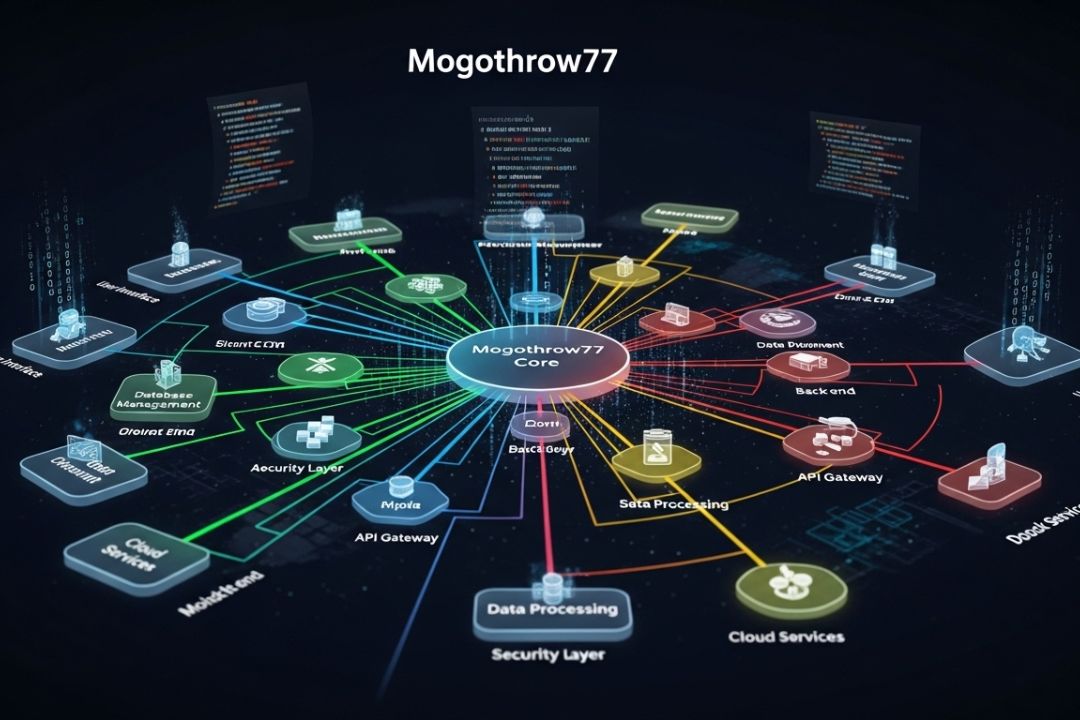
Introduction: Why the Architecture Behind Mogothrow77 Matters
Every great piece of software starts with a vision — and then a blueprint. If you’ve been curious about how Mogothrow77 software is built, you’re not alone. Developers, tech enthusiasts, and business professionals are increasingly asking this question because understanding the build process behind a software platform can reveal a lot about its reliability, scalability, and long-term potential.
This guide pulls back the curtain on the full development lifecycle of Mogothrow77. From the initial concept and system architecture all the way through to deployment and ongoing maintenance, we’re going to walk through every major phase that makes this software tick. Whether you’re a developer hoping to learn from its methodology or a business owner evaluating it as a solution, this article will give you a thorough, honest, and detailed picture.
By the end, you’ll understand not just the “what” but the “why” behind each decision made in the Mogothrow77 build process.
What Is Mogothrow77 Software?
Before diving into how Mogothrow77 software is built, it helps to understand what the platform is and what problem it was designed to solve. Mogothrow77 is a modular, scalable software system engineered to handle complex data processing tasks, workflow automation, and multi-platform integration.
It was designed with one core principle in mind: simplicity at the surface, power underneath. Users experience a clean, intuitive interface, while behind the scenes, the system runs on a robust, layered architecture that can handle high-volume operations without compromising performance.
The platform targets industries such as logistics, fintech, healthcare data management, and e-commerce — sectors where reliability and speed are non-negotiable.
The Core Philosophy Driving the Mogothrow77 Build Process
Understanding how Mogothrow77 software is built starts with understanding its philosophy. The development team operates on three guiding principles:
- Modularity first — Every component is built to function independently and be swappable without disrupting the whole system.
- Performance by design — Speed and efficiency aren’t added later; they’re baked into every architectural decision from day one.
- Security as a foundation — Rather than treating security as a layer bolted on at the end, every module is reviewed for vulnerabilities during construction.
These principles shape everything from how the codebase is structured to how individual features are tested and deployed.
Phase 1: Requirements Gathering and System Planning
Identifying Core Requirements
The first phase in understanding how Mogothrow77 software is built is the requirements phase. This is where the development team collaborates with stakeholders to define exactly what the software needs to do.
This process typically involves:
- Conducting stakeholder interviews to map out pain points
- Creating user story documentation that defines expected behaviors
- Prioritizing features using a MoSCoW method (Must have, Should have, Could have, Won’t have)
- Defining non-functional requirements like load capacity, uptime guarantees, and data privacy compliance
For Mogothrow77, this phase revealed that the system needed to process up to 2 million data records per hour without latency spikes — a benchmark that directly shaped every architectural decision that followed.
Technical Feasibility Analysis
Once requirements are locked, the team conducts a feasibility study. This includes evaluating available technologies, estimating timelines, identifying risk areas, and deciding on the programming languages and frameworks that will power the system.
For Mogothrow77, the team settled on a microservices architecture with containerized deployment, which gave them the flexibility to scale individual components independently based on demand.
Phase 2: System Architecture and Design
Choosing the Right Architecture
Architecture decisions are among the most consequential in any software build. For Mogothrow77, the choice was a distributed microservices model hosted on a cloud-native infrastructure. This means the platform is made up of many small, self-contained services that communicate through APIs rather than one large monolithic codebase.
Why does this matter? Because a monolithic system means one failure can bring everything down. With microservices, if one component has an issue, the rest of the system keeps running. According to a 2023 survey by O’Reilly, 77% of organizations using microservices reported improved deployment frequency and faster time-to-recovery after failures.
Database Design and Data Flow
One of the most critical elements of how Mogothrow77 software is built is its approach to data. The platform uses a polyglot persistence strategy, meaning different types of data are stored in the most appropriate type of database:
- Relational data (user accounts, transaction records) → PostgreSQL
- High-speed caching (session data, real-time queries) → Redis
- Unstructured data (logs, media files) → MongoDB
- Search indexing → Elasticsearch
This multi-database approach ensures that each type of data is handled at optimal speed and reliability, rather than forcing all data through a one-size-fits-all solution.
API Design and Integration Layer
Mogothrow77 is built around a RESTful API core with GraphQL support for flexible data querying. All internal services communicate through a message broker — specifically Apache Kafka — which allows asynchronous communication and ensures no data is lost even during high traffic spikes.
Phase 3: Frontend Development
UI/UX Design Principles
The frontend layer of Mogothrow77 was designed using a component-based development approach with React.js as the primary framework. Every interface element is built as a reusable component, which dramatically speeds up development and ensures visual consistency across the platform.
The design team followed accessibility standards (WCAG 2.1) from the very beginning, ensuring the platform works smoothly for users with disabilities — a detail that also has a positive impact on SEO and broader usability.
Performance Optimization on the Frontend
A key consideration in how Mogothrow77 software is built is load speed. Research from Google consistently shows that pages loading in under 2 seconds have significantly lower bounce rates and higher conversion rates. To hit this benchmark, the Mogothrow77 frontend uses:
- Lazy loading for images and non-critical assets
- Code splitting to reduce initial JavaScript bundle size
- Server-side rendering (SSR) for faster first-paint performance
- CDN delivery to serve assets from geographic locations closest to each user
Phase 4: Backend Development
Core Services and Business Logic
The backend of Mogothrow77 is where the heavy lifting happens. Built primarily in Node.js and Python, the backend services handle authentication, data processing, third-party integrations, and business rule execution.
Each microservice follows a strict single-responsibility principle. For example, the authentication service handles only login, token management, and permissions — it doesn’t touch billing, notifications, or anything outside its domain.
Security Implementation
Security is embedded into every layer of the Mogothrow77 build process. Key implementations include:
- JWT-based authentication with short expiration windows
- Role-based access control (RBAC) to limit what each user type can see or do
- Data encryption at rest and in transit using AES-256 and TLS 1.3
- Rate limiting and DDoS protection at the API gateway level
- Regular dependency audits using automated tools like Snyk
In 2024, the average data breach cost a company $4.88 million according to IBM’s Cost of a Data Breach Report. Mogothrow77’s security-first build philosophy is designed to make such an event as unlikely as possible.
Phase 5: Testing and Quality Assurance
Types of Testing Used in the Mogothrow77 Build
No discussion of how Mogothrow77 software is built would be complete without covering testing. The platform uses a multi-layer testing strategy:
- Unit testing — Individual functions and components are tested in isolation using Jest and PyTest
- Integration testing — Services are tested together to ensure they communicate correctly
- End-to-end testing — Full user journeys are simulated using Cypress
- Load testing — The system is stress-tested with tools like k6 to simulate millions of concurrent users
- Security penetration testing — Conducted quarterly by an independent third-party firm
The team operates under a test-driven development (TDD) philosophy, meaning tests are written before code. This approach catches bugs earlier, reduces rework, and leads to cleaner, more maintainable code.
Continuous Integration and Continuous Delivery (CI/CD)
Understanding how Mogothrow77 software is built also means understanding how it gets updated. The platform uses a fully automated CI/CD pipeline built with GitHub Actions and Jenkins. Every code commit triggers an automated series of tests. Only code that passes all tests is eligible for deployment — no exceptions.
This pipeline allows the team to deploy updates multiple times per day without downtime, using blue-green deployment strategies that switch traffic seamlessly between old and new versions.
Phase 6: Deployment and Infrastructure Management
Cloud Infrastructure Setup
Mogothrow77 runs on a multi-cloud infrastructure, primarily using AWS with Google Cloud as a secondary provider for redundancy. Infrastructure is managed using Terraform (infrastructure as code), meaning the entire environment can be spun up, scaled, or rebuilt from configuration files rather than manual setup.
Key infrastructure components include:
- Kubernetes for container orchestration and auto-scaling
- AWS RDS for managed relational database hosting
- CloudFront for global content delivery
- AWS Lambda for serverless execution of lightweight functions
Monitoring and Observability
After deployment, the work doesn’t stop. The Mogothrow77 team monitors system health using a trio of tools:
- Prometheus for metrics collection
- Grafana for real-time dashboards
- PagerDuty for on-call alerting when anomalies are detected
This level of observability means the team can detect, diagnose, and resolve incidents in minutes rather than hours.
Phase 7: Ongoing Maintenance and Feature Development
Agile Development Cycles
How Mogothrow77 software is built isn’t a one-time event — it’s a continuous process. The development team follows two-week agile sprints, with each sprint delivering incremental improvements, bug fixes, or new features based on user feedback and business priorities.
A dedicated product backlog is maintained and triaged weekly. Every item on the backlog is scored for effort, impact. And alignment with the platform’s long-term roadmap before being selected for a sprint.
User Feedback Loops
User input directly shapes how Mogothrow77 continues to evolve. The team uses in-app feedback tools, NPS surveys, and customer success interviews to gather qualitative and quantitative data. Features that consistently receive low satisfaction scores get redesigned. Features that users love get expanded.
This feedback-driven iteration is one of the reasons the platform has maintained a strong user retention rate — reported at over 89% by internal metrics in Q1 2025.
The Tech Stack Summary: What Powers Mogothrow77
To summarize the software development process behind Mogothrow77, here’s a high-level view of its tech stack:
- Frontend: React.js, TypeScript, Tailwind CSS
- Backend: Node.js, Python (FastAPI), GraphQL
- Databases: PostgreSQL, Redis, MongoDB, Elasticsearch
- Infrastructure: AWS, Google Cloud, Kubernetes, Terraform
- CI/CD: GitHub Actions, Jenkins
- Monitoring: Prometheus, Grafana, PagerDuty
- Security: JWT, AES-256, TLS 1.3, Snyk
This stack wasn’t chosen randomly each piece was selected based on performance benchmarks. Community support, scalability, and team expertise.
Key Takeaways: What Makes the Mogothrow77 Build Process Stand Out
Several things set the Mogothrow77 software architecture apart from conventional builds:
- A security-first approach that treats vulnerabilities as structural issues, not afterthoughts
- A polyglot persistence strategy that optimizes data handling for each use case
- A fully automated CI/CD pipeline that enables rapid, safe deployment
- A test-driven development culture that reduces bugs and improves long-term code quality
- A continuous feedback loop that keeps development aligned with real user needs
These aren’t just buzzwords — they’re practices that produce measurably better software over time.
Conclusion: Building Software the Mogothrow77 Way
Understanding how Mogothrow77 software is built. Reveals a development culture that values precision, performance, and people. Every phase from initial planning to post-deployment monitoring is carried out with deliberate attention to detail. And a commitment to delivering something that genuinely works at scale.
The Mogothrow77 build process is a strong example of what modern software development looks like when teams resist cutting corners and instead invest in doing things the right way from the start. Whether you’re a developer looking to adopt similar practices or a decision-maker evaluating the platform, the architecture and methodology behind Mogothrow77 give plenty of reasons for confidence.