
Every click on your website represents a potential customer, but not every visitor becomes one. Understanding the gap between traffic and actual conversions is where CVR becomes your most valuable metric. If you’re spending money on digital advertising but struggling to measure real results, mastering conversion rate will transform how you evaluate marketing success.
In the fast-paced world of online business, knowing what CVR means in digital marketing isn’t just helpful—it’s essential for survival. This comprehensive guide will walk you through everything you need to know about conversion rates, from basic definitions to advanced optimization strategies that can dramatically improve your bottom line.
Understanding CVR: The Foundation of Digital Marketing Success
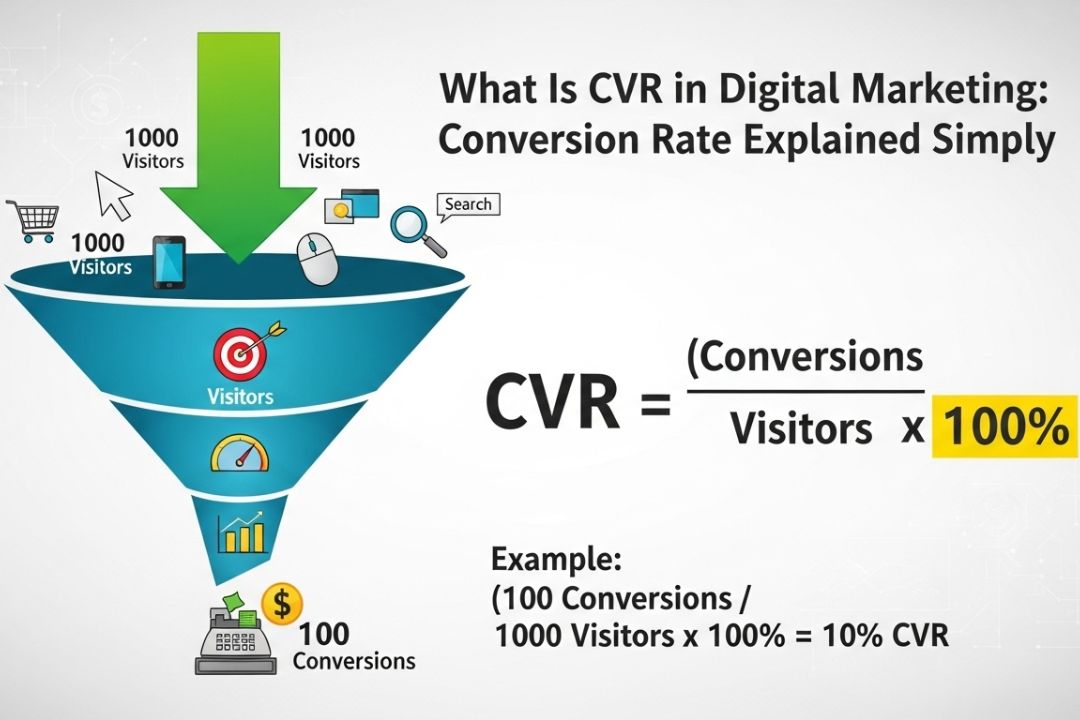
What is CVR in digital marketing? CVR stands for Conversion Rate, and it measures the percentage of visitors who complete a desired action on your website or landing page. This action could be making a purchase, signing up for a newsletter, downloading an ebook, or filling out a contact form.
The beauty of CVR lies in its simplicity. Unlike complex metrics that require advanced analytics knowledge, conversion rate gives you a straightforward picture of how effectively your marketing efforts turn prospects into customers. When you understand your conversion rate, you gain insight into whether your marketing dollars are working hard or hardly working.
Think of CVR as the health check for your digital marketing campaigns. Just as a doctor uses vital signs to assess your physical health, marketers use conversion rate to diagnose the effectiveness of their online presence.
The Mathematics Behind Conversion Rate
Calculating what is CVR in digital marketing requires a simple formula that anyone can master:
CVR = (Number of Conversions / Total Number of Visitors) × 100
Let’s break this down with a practical example. Suppose your online store received 5,000 visitors last month, and 150 of them made a purchase. Your conversion rate would be:
CVR = (150 / 5,000) × 100 = 3%
This means that 3% of your website visitors became paying customers. While this might seem like a small number, a 3% conversion rate is actually quite respectable in many industries. The key is understanding what constitutes a good conversion rate for your specific sector and continually working to improve it.
Why CVR Matters More Than Traffic Alone
Many business owners become obsessed with increasing website traffic, believing that more visitors automatically means more sales. This approach misses a critical point. You could have 100,000 visitors with a 1% conversion rate, resulting in 1,000 sales. Meanwhile, a competitor with only 20,000 visitors but a 6% conversion rate would generate 1,200 sales with significantly less traffic.
Understanding what is CVR in digital marketing helps you shift focus from vanity metrics to results that actually impact revenue. Here’s why conversion rate optimization deserves your attention:
Cost Efficiency: Improving your conversion rate means getting more value from your existing traffic without spending extra money on advertising. If you double your conversion rate, you effectively double your revenue without increasing your marketing budget.
Better ROI: When you know your conversion rate, you can accurately calculate return on investment for every marketing channel. This allows you to allocate resources to campaigns that deliver real results rather than just impressive-looking traffic numbers.
Customer Insights: Analyzing conversion rates across different pages and campaigns reveals what resonates with your audience. These insights help you create more effective marketing messages and improve user experience.
Industry Benchmarks: What’s a Good Conversion Rate?
One of the most common questions marketers ask when learning what is CVR in digital marketing is: “What conversion rate should I aim for?” The answer varies dramatically depending on your industry, product type, and target audience.
According to recent industry research, the average conversion rate across all industries hovers around 2-3%. However, this broad average hides significant variations:
- E-commerce websites typically see conversion rates between 1-3%
- B2B lead generation pages often achieve 5-10% conversion rates
- Landing pages for free trials or downloads can reach 10-15%
- Email marketing campaigns might see conversion rates of 15-25%
Professional services and high-ticket items generally have lower conversion rates because the decision-making process takes longer. Conversely, low-cost impulse purchases or free offers tend to convert at higher rates.
Rather than comparing yourself to industry averages, focus on your own baseline and continuous improvement. A company that increases its conversion rate from 2% to 3% has achieved a 50% improvement in performance—a massive win regardless of how it compares to competitors.
Different Types of Conversions in Digital Marketing
When exploring what is CVR in digital marketing, it’s important to recognize that conversions come in many forms. Not every conversion involves a direct sale. Understanding the different conversion types helps you build a comprehensive marketing funnel:
Macro Conversions
These are your primary business goals, typically involving direct revenue generation:
- Completed purchases on e-commerce sites
- Signed service contracts
- Scheduled consultations for high-value services
- Subscription sign-ups for paid products
Micro Conversions
These smaller actions indicate interest and move prospects closer to becoming customers:
- Newsletter subscriptions
- Social media follows
- Content downloads (whitepapers, ebooks, templates)
- Video views
- Free trial activations
- Adding items to shopping carts
Both macro and micro conversions matter. While macro conversions directly impact revenue, micro conversions build relationships and nurture prospects through the buyer’s journey. Tracking both types gives you a complete picture of your marketing funnel performance.
Key Factors That Influence Your Conversion Rate
Understanding what is CVR in digital marketing also means knowing what drives those numbers up or down. Numerous factors affect whether visitors convert, and successful marketers pay attention to all of them:
Website Speed and Performance
Research shows that 40% of visitors abandon a website that takes more than three seconds to load. Every additional second of loading time can decrease conversion rates by 7%. In our instant-gratification digital world, patience is virtually non-existent.
Mobile Optimization
With mobile devices accounting for over 60% of web traffic, a mobile-friendly experience is non-negotiable. If your site doesn’t display properly on smartphones, you’re losing more than half your potential conversions before visitors even see your offer.
Clear Value Proposition
Visitors need to immediately understand what you’re offering and why it matters to them. Confusion is the enemy of conversion. Your headline, images, and primary message should communicate value within seconds of landing on the page.
Trust Signals
Security badges, customer testimonials, professional design, clear contact information, and transparent pricing all build trust. People won’t convert if they don’t trust your business, especially for first-time purchases or when sharing personal information.
Call-to-Action Quality
Your CTA button or link is the gateway to conversion. The text, color, size, placement, and surrounding whitespace all influence whether people click. “Buy Now” might work for impulse purchases, while “Schedule Your Free Consultation” could be better for professional services.
Proven Strategies to Improve Your CVR
Now that you understand what is CVR in digital marketing and why it matters, let’s explore actionable tactics to boost your conversion rate:
Simplify Your Forms
Every field you add to a form decreases completion rates. Ask only for information you absolutely need at this stage. You can always collect additional details later in the customer relationship.
Implement A/B Testing
Test different versions of headlines, images, CTAs, page layouts, and copy to discover what resonates with your audience. Even small changes can yield significant improvements. Companies that consistently run A/B tests see average conversion rate increases of 49% according to marketing research.
Improve Your Copy
Words matter enormously in digital marketing. Focus on benefits rather than features, address customer pain points directly, use specific numbers instead of vague claims, and create urgency without resorting to manipulative tactics.
Reduce Friction in the Checkout Process
For e-commerce, streamline your checkout flow by offering guest checkout options, displaying security badges prominently, showing progress indicators, providing multiple payment methods, and being transparent about shipping costs early in the process.
Use Social Proof Strategically
Display customer reviews, showcase impressive client logos, highlight the number of satisfied customers, share case studies with specific results, and feature user-generated content when possible.
Common CVR Mistakes That Kill Conversions
Even experienced marketers sometimes make errors that sabotage their conversion rates. Avoid these common pitfalls:
Ignoring Mobile Users: Designing only for desktop creates a terrible experience for the majority of your audience who browse on smartphones.
Too Many Choices: Paradoxically, offering too many options can paralyze decision-making. This phenomenon, called “choice overload,” causes people to make no decision at all rather than choosing from overwhelming options.
Slow Page Speed: We mentioned this earlier, but it bears repeating. Technical performance directly impacts conversion rates, yet many businesses neglect website optimization.
Weak or Confusing CTAs: If visitors can’t figure out what action to take next, they won’t take any action. Make your desired next step crystal clear.
Not Testing Assumptions: What you think will work and what actually works are often very different. Data beats opinions every time.
Tools and Analytics for Tracking Conversion Rates
Understanding what is CVR in digital marketing requires the right tools to measure and analyze your performance. Fortunately, powerful analytics platforms make this easier than ever:
Google Analytics remains the gold standard for free website analytics. It tracks conversions, identifies high-performing pages, shows visitor behavior flows, and reveals where people drop off in your funnel.
Heatmap Tools like Hotjar or Crazy Egg show you exactly where visitors click, how far they scroll, and what elements they ignore. This visual data reveals optimization opportunities that raw numbers might miss.
A/B Testing Platforms such as Optimizely or VWO allow you to run controlled experiments comparing different page versions to see which converts better.
CRM Systems with built-in analytics help you track conversions through the entire customer journey, from first website visit to final purchase and beyond.
The key isn’t using every tool available but choosing the right combination for your business needs and actually acting on the insights they provide.
Real-World CVR Success Stories
Theory is valuable, but real examples bring the concept to life. Here are scenarios showing how businesses improved their conversion rates:
A subscription box company was struggling with a 1.2% conversion rate on their landing page. After implementing A/B tests, they discovered that changing their CTA from “Subscribe Now” to “Get Your First Box” increased conversions to 2.8%—a 133% improvement. The more specific language helped visitors visualize the tangible benefit they’d receive.
An online education platform had a detailed six-field form for their free course trial. When they reduced it to just email address and password, their conversion rate jumped from 8% to 21%. The lesson? Sometimes less really is more.
A B2B software company added customer testimonials with specific results and company logos to their pricing page. This single change increased their conversion rate from 3.1% to 4.7%, representing significant additional revenue with no increase in traffic or advertising spend.
The Relationship Between CVR and Other Marketing Metrics
What is CVR in digital marketing when considered alongside other important metrics? Conversion rate doesn’t exist in isolation—it interacts with every aspect of your marketing performance:
Traffic Quality vs. Quantity: High traffic with low conversion rate often indicates a targeting problem. You’re attracting the wrong audience. Conversely, low traffic with high conversion rate suggests you’ve nailed your targeting but need to expand your reach.
Customer Lifetime Value (CLV): A lower conversion rate might be acceptable if the customers you do acquire have exceptionally high lifetime value. Sometimes quality trumps quantity.
Cost Per Acquisition (CPA): Your conversion rate directly affects how much you pay to acquire each customer. Double your conversion rate, and you cut your acquisition cost in half.
Bounce Rate: High bounce rates and low conversion rates often go hand-in-hand, indicating that your landing page isn’t meeting visitor expectations.
Understanding these relationships helps you make smarter marketing decisions and allocate resources more effectively.
Future Trends in Conversion Rate Optimization
The digital marketing landscape constantly evolves, and conversion rate optimization evolves with it. Here are emerging trends shaping the future:
Artificial Intelligence and Personalization: AI-powered tools now enable real-time personalization at scale, showing different content to different visitors based on their behavior, demographics, and preferences. This hyper-personalization can dramatically improve conversion rates.
Voice Search Optimization: As voice-activated devices become ubiquitous, optimizing for voice search queries will become essential for maintaining strong conversion rates.
Interactive Content: Calculators, quizzes, assessments, and interactive tools engage visitors more effectively than static content, often leading to higher conversion rates.
Privacy-First Marketing: With increasing privacy regulations and the phasing out of third-party cookies, marketers will need to focus on first-party data collection and transparent value exchanges to maintain conversion rates.
Staying ahead of these trends ensures your conversion rate optimization efforts remain effective in a changing digital ecosystem.
Conclusion: Mastering CVR for Digital Marketing Success
Understanding what is CVR in digital marketing provides the foundation for measuring and improving your online business performance. Conversion rate isn’t just another metric to track—it’s the bridge between marketing activity and business results.
By focusing on conversion rate optimization, you maximize the value of every visitor, improve return on investment, and build a more sustainable business model. Remember that improvement is a continuous process, not a one-time project. The most successful digital marketers constantly test, measure, refine, and optimize their conversion funnels.
Start by establishing your baseline conversion rate across different channels and campaigns. Identify your biggest opportunities for improvement, implement changes systematically, and measure results rigorously. Even modest improvements compound over time to create substantial business impact.
Ready to transform your digital marketing performance? Begin tracking your conversion rates today, implement the strategies outlined in this guide, and watch your results improve month after month.